Can you tell me “What works in…”

Although we reportedly now live in a post-evidence era, I still choose to cling to the minority view that programmes should be informed by research about what works. But where do you find the evidence?

About two years ago I attended a training course presented by Phil Davies from 3ie. He had many interesting insights to share, but today I was reminded of this excellent list of synthesised evidence that he shared.

One of my recent favourite systematic reviews, conducted by 3ie is The impact of education programmes on learning and school participation in low- and middle-income countries by Snilstveit et al . It has evidence about supplementary education programmes, feeding programmes, ICT in education programmes and a wide range of others. 
Happy Reading!  

Simple Evaluation Tools

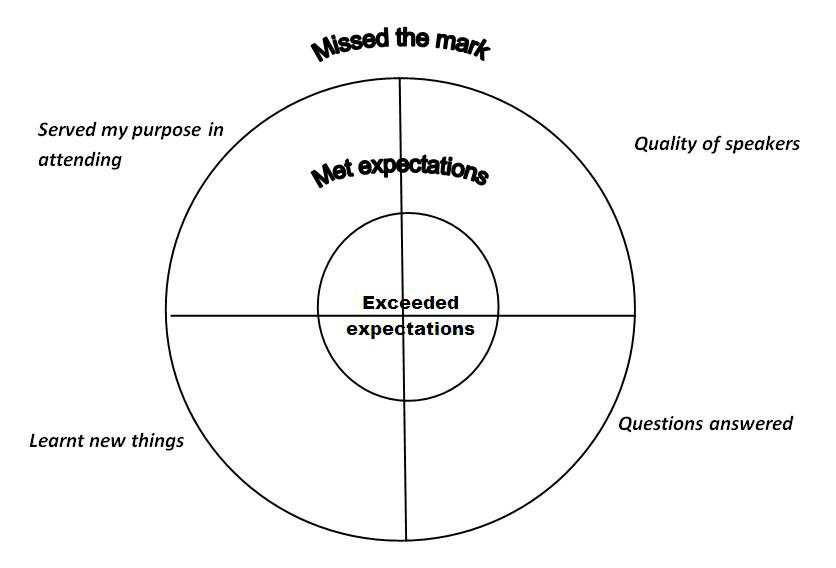
I’m starting a project soon where I will have to develop and compile really simple Evaluation materials for organizations that may not have a lot of expertise to do M&E. Here is one of the really simple but striking tools that I came across at the community sustainability engagement evaluation toolbox

Getting the right tools into people’s hands is of course only part of the solution to making sure evaluation at grass roots improve. Sometimes it is less the case that people don’t know how to do M&E, and more that they are spread too thin to also do M&E….

Sense Maker

In a previous post, I ventured that we should start questioning the archaic. Our methods and our ways of communicating results haven’t changed much over the past 10 years or so, despite new technologies and preferences.

I have posted a number of examples of interesting data visualizations, but the clip below introduces a new way of collecting information, with the help of a product called Sensemaker

Here Irene Guijt talks about Sensemaker in the context of Evaluation.

Here is an article in the Stanford Social Innovation Review about a real life application done by Global Giving.

22 Seems to be the Magic Number in Solving Education problems!

In a previous post, I introduced the book by Stuart S. Yeh Entitled “The Cost-Effectiveness of 22 Approaches for Raising Student Achievement”.
Now the World Bank released a report entitled “Making Schools Work – New Evidence on Accountability Reforms” which is based on 22 recent impact evaluations of accountability-focused reforms in 11 developing countries. I wonder why this fascination with the number 22?

In the book (written by Barbara Burns, Deon Filmer and Harry Anthony Patrinos) they investigate strategies to address “service delivery failures” where increased spending does not lead to a concomitant change in education output (completion) or outcomes (learning). The idea is that if people in the schooling system are held accountable, things will improve.

This book focuses specifically on

three key strategies to strengthen accountability relationships in school systems—information for accountability, school-based management, and teacher incentives

 and looks into how these can affect school enrolment, completion, and student learning.

Main findings about the three strategies include:


Information for accountability (for example – providing “school report cards”) seems to work, but it isn’t a solution to all the problems. Which information is shared, who it is shared with and how it is shared are important considerations which could help parents, communities and other role players identify where the weaknesses in the system is.


School based management reforms (e.g. implementing effective school governance, and school based management) are effective, but these “reforms need at least five years to bring about fundamental changes at the school level and about eight years to yield significant changes in test scores”


Teacher incentives of two kinds have been investigated: Contract teachers (where teachers are contracted on condition that they deliver certain results), and pay for performance reforms (bonuses from meeting targets) seem to be successful too, but perverse behaviours (Such as gaming, cheating or teaching to the test) are likely to abound and eventually negate the overall success of this strategy.

We’ve seen some progress in this regard in the South African schooling system: School Management and Governance training remains an important component of “whole school” development, and the implementation of the Annual National Assessments (ANA) is likely to evolve into an “information for accountability” initiative. (Also see this article about the ANA’s in the local press). Perhaps its time to take the hand of the labour unions and see how incentivising teachers can be implemented?

Better Evaluation Virtual Writeshop

Irene Guijt posted this on the Pelican List serv today

Perhaps you have undertaken an evaluation on a program to mitigate climate change effects on rural people living in poverty, or one on capacity development in value chains. Or worked on participatory ways to make sense of evaluation data, or developed simple ways to integrate numbers and stories. We’d like to bring unknown experiences to the global stage for wider use.

Do you have an experience that covers many different aspects of evaluation – design, collection, sensemaking, and reporting? Did you look at different options to develop a context-sensitive approach? And has your evaluation process not yet been shared widely? If your answer is yes to these questions, then our virtual writeshop on evaluation may be of interest.

We will facilitate a virtual writeshop between May and September 2011 that will lead to around 10 focused documents to be shared globally. Participating in the writeshop will give you structured editorial support and peer review to develop a publication for the BetterEvaluation site.

For more information, including how to submit a proposal, go here.

22 Approaches for Raising Student Achievement

I’m working my way through a book by Stuart S. Yeh Entitled “The Cost-Effectiveness of 22 Approaches for Raising Student Achievement” (Also available as an ebook http://ow.ly/4R62s or on paper from www.loot.co.za see: http://ow.ly/4RRll)


The book (based on Studies in the States) concludes that:

The review of cost-effectiveness studies suggests that rapid assessment is more cost effective with regard to student achievement than comprehensive school reform (CSR), cross-age tutoring, computer-assisted instruction, a longer school day, increases in teacher education, teacher experience or teacher salaries, summer school, more rigorous math classes, value-added teacher assessment, class size reduction, a 10% increase in per pupil expenditure, full-day kindergarten, Head Start (preschool), high-standards exit exams, National Board for Professional Teaching Standards (NBPTS) certification, higher teacher licensure test scores, high-quality preschool, an additional school year, voucher programs, or charter schools

.

I find this interesting, because this makes a very compelling argument for using computer based learning in schools. The first chapter of the book presents a nice theoretical overview that indicates how kids become disheartened if they don’t consistently have mastery experiences. If assessment and teaching can be individualized so that each learner progressively improves compared to their previous performance (rather than a comparison with peers) they are likely to feel that they are in control of their learning, and they would be more likely to stay engaged in the learning process. The chapter states:

A theory of learning may be deduced: Individualization of assessment, task difficulty and performance expectations for each student on a daily basis, in combination with performance feedback, autonomy in task execution and an accelerating standard of performance, ensures that students achieve success and feel successful on a daily basis, fostering student engagement, increased effort, and further improvements in achievement in a virtuous cycle.

Software can automate the provision of corrective feedback, and assigning of content (on a daily basis) and this has been shown to have powerful effects on learning and achievement. Yeh reports that in a study of Math Assessment, (involving 1,880 students in grades 2 through 8, 80 classrooms and seven states) they found an effect size of 0.324 Standard deviations over a 7 month period. This is a huge increase in learner performance.

Of course we need to remember that this is based on the American school system that is very different from ours. And note the study is about “Cost Effectiveness”. It is not saying that the other strategies are not effective – In their context the other strategies were effective but at a higher cost than Rapid Assessment

Of course there are a few other assumptions that will have to be checked if a similar intervention is implemented in South Africa:
1) Computer infrastructure, technical support, and teacher’s abilities must be supportive of successful implementation. It is a lot harder to implement an ICT based project than one might imagine at the outset.
2) Rapid assessment cannot replace the role of the teacher – It can help learners improve, but they still have to get quality tuition from a qualified teacher.
3) Learners’ ability to interact with the software must not be blocked by poor reading / language capabilities.

GIS Data and Maps to Find South African Health Facilities

Here is a neat resource I came across at the ESI Data Quality Conference held in March.

It contains some basic data and various layers of health facility data in South Africa, and allows easy map sharing. Check it out at:

http://www.mapsharing.org.za:8008/mapguide/fusion/templates/mapguide/slate/

Some Educational ICT solutions I’ve come across

VITALmaths which is a collection of video clips that’s accessible from cellphone. They demonstrate basic maths concepts.

LearnThings which provides online learning resources for Maths and Science teaching.

Crocodile Clips a variety of maths games.

Connexions a repository of online teaching and learning resources.

Master Maths M2 Computer Based Training proprietary software for self paced Maths Learning

NovaNet and Success Maker proprietary software from the USA for self paced learning available through a South African distributor

Tools to create infographics.

This post from Fast company provides an overview of some tools for creating info graphics.

They discuss:
Many Eyes
Which allows you to visually represent some data sets that they have available, or allows you to upload your own to play with.

Google Public Data Explorer
Which is a public version of one of Google’s research tools.

Hohli
Which helps you to create and customzie Venn Diagrams. Hohli also allows you to create other charts, including scatter plots and other line charts.

Wordle
Although this tool describes itself as a “toy” for generating word clouds, it can be an effective service to spruce up your work.

Visual.ly
Is a new tool (still being tested), that will allow you to create and share infographics. From a first look on YouTube, this new service will be a great resource to create a compelling storytelling visualization. A youtube clip explains it all

Using Dashboards to communicate findings

Shaku Atre says:
“The fundamental premise of business intelligence has traditionally been “to provide the right information to the right people at the right time and at the right cost.” While this statement is irrefutable, it would be more accurate if we changed the word “information” to “actionable information.”

This sounds quite similar to the UFE focus of ensuring that evaluation findings are available to the intended users for the intended use!

In communicating results in a useful manner, this resource http://ow.ly/4xlQn from Information Management shares some interesting ideas about Dashboards.

Hypothetical Crucial Confrontations

Every Utilization Focused Evaluator knows: If an evaluation deliverable is submitted late, it can potentially totally negate the reason for doing the evaluation in the first place. If the intended user does not have the information at his/her disposal when the time for the intended use comes, you have a disaster.

Late delivery and a whole range of unpleasant consequences can be prevented, if you have the skill of holding people accountable for broken promises along the way. I find holding my team accountable is relatively easy, but holding a client accountable for broken commitments, is quite a different ballgame- A very unpleasant and daunting one!

Imagine the following totally hypothetical* example: You are working with a client who commits to giving feedback on deliverables by a certain date, and by the time you get to that date, there is no feedback. Or no consequential feedback. Then you try to get sign-off on deliverables, but a second and third round of comments follow, and it takes forever to move along. Hypothetically speaking, it could take you 8 months to get sign off on one deliverable!

It could be really difficult to work effectively with such a (hypotehtical) client, and you may start to doubt your own ability to execute. I cringe if I look at it from the hypothetical client’s perspective – and I’m not sure what this must look like to a hypothetical innocent bystander.

Evaluation team leaders need to be able to hold their clients accountable for broken commitments, else the team may be heading for a deep and dark place where everyone just ends up hating working together.

I’m reading a book called “Crucial Confrontations” on exactly this topic. It is packed with so many interesting concepts. I can highly recommend it. See: http://ow.ly/4waEW (Also available on Kindle!)

The book has taught me to be a little bit more discerning about the actual problem that needs to be addressed (amongst other things). Who would’ve thought that what seems like a simple (hypothetical) problem can actually be so very complex?

1) If the problem is a single instance of not receiving feedback all you need to do is follow up with the client until he / she has met his / her commitment. Getting the feedback once, means the problem is resolved.

2) If the problem is a pattern of broken commitments, just dogging the client until he/ she provides feedback will probably only resolve the problem until the next round of feedback is due. Perhaps the process of feedback and signoff should be changed, to break this pattern?

3) But the problem may be a relationship problem. If the client is in a difficult position in his / her organization he / she may be unable to act quickly / definitively / at all. No amount of process change will solve this quandary. If a pattern of broken commitments have lead to tensions in the relationship between the client and the evaluator, interacting is likely to become more difficult as time goes by, and more commitments will be broken. The solution that is required, is a fix for the relationship!

The book has so many other good suggestions, which would be very handy in planning interactions with a hypothetical problem client. May you never have the need of applying these skills!

**********************************************************************
*My husband says that when people say “theoretically” they mean “not really”. When I say hypothetically, I mean exactly that!

AEA 365

The American Evaluation Association has this AEA365 service, which is really cool. I love what they have done with it. I only today managed to look at it in detail and its now my new favourite resource to recommend to new evaluators.

See www.eval.org aea365 Tip-a-Day Email Alerts: We’re highlighting hot tips, cool tricks, rad resources, and lessons learned for and from evaluators Evaluation Tip-a-Day Emails

In 2007 I actually wrote a concept note for a service like this when I was at an AfrEA workshop in Niamey, Niger. Subsequently I mentioned it at the SAMEA conference as a potential service and everyboy thought it was a good idea. But I just did not have the resources at my disposal to make it happen. During that time I was invovled in running the operations of SAMEA and later AFREA so all my volunteer time and inspiration was swallowed up there. And although I thought that graduate students might be best placed to start compiling the content, I just never could find someone that would be willing to drive such an idea. So I am soooooooo happy that AEA had the same smart idea and were actually able to pull together the resources to make it a reality.

Check out the GOODs

A colleague referred me to a refreshing website that might be interesting to do-gooders the world over. It is called GOOD.

Maybe they called it GOOD because it can be found at the following url: http://www.good.is/. Apparently “GOOD is a collaboration of individuals, businesses, and nonprofits pushing the world forward”

Maybe they called it GOOD because it is good. I remind you, dear reader, that I am an evaluator so I should – according to the Scrivenian* wisdom I sometimes subscribe to – be particularly well placed to pass judgements about merit and worth. However, I will reserve judgement about the Goodness of GOOD for now. Except for saying what I have already said about it.

There is an interesting blog about Innovation and Evaluation in philanthropy. See

http://www.good.is/post/innovation-and-evaluation-are-inseparable/

*OK, that only sounded GOOD in my head, but the meaning I’m hoping to convey is that Michael Scriven’s writings are relevant here.

ELDIS RESOURCE

http://www.eldis.org/go/topics/resource-guides/manuals-and-toolkits/monitoring-and-evaluation

The Eldis Community site enables development professionals across the world to debate, discuss and exchange ideas and information. This community group, focusing on results-based M&E, is composed of development evaluation practitioners committed to evaluation capacity building at all levels of human development activities – global, country or community level; policy, programme or project level – with the aim of bringing about an equitable, accountable and progressive society for everyone.

Metrics for Social Entrepreneurs

I found this website aimed at social entrepreneurs quite useful.
http://www.socialedge.org/discussions/success-metrics/new-metrics-for-today-s-social-entrepreneurs/

It lists some approaches for measurement:
“Social entrepreneurs now have a smorgasbord of measurement methodologies to choose from in addition to developing project-specific metrics (i.e., families served, reduction in arrests, units built, jobs created). They include:

• Balanced Scorecard Methodology (New Profit Inc.)
• The Acumen-Mckinsey Scorecard (Acumen Fund)
• Social Return Assessment Scorecard (Pacific Community Ventures)
• AtKisson Compass Assessment for Investors (AtKisson)
• Poverty and Social Impact Analysis (World Bank)
• OASIS: Ongoing Assessment of Social Impacts (REDF)”

They also extract Five principles of metrics that are often mentioned in discussions

1. Do have a set of success metrics
Funders and investors want to know that you have a way of measuring your success.
2. Tailor your metrics to your mission
If you are running a non-profit, then focus on social impact; if you are running a for-profit, you need the third bottom line – ROI.
3. Measure what you can in real time, but understand that social change is often measurable only over a longer period.
Try to find polling and survey organizations that are measuring the long-term trends and use their free published data.
4. Learn about established methodologies for social measurements
Applying them will save you work, get better results, and signal investors that you are serious about metrics.
5. Look at the cost-benefit of your metrics
Determine what percentage of your operations should be reasonably dedicated to success measurement and set it aside in your proposal and operating budgets.

Personally, I think that the issue of Return on Investment is crucial for any social entrepreneur. You need to be able to prove to your donors that they are getting value for money – Too many times teachers are trained at the cost of training and astronaut.

The Global Classroom – Direct from Claremont Graduate University

This very useful resource was brought under my attention via the AEA and SAMEA listservs.

The panel discussions from Claremont Graduate University ‘s recent “What Works?” workshops are available for viewing online as part of our video library. Evaluators, foundation directors, academics, and leaders of successful for-profits and non-profits came together to discuss what really works when tackling important social problems.

To view this footage, visit us at: http://www.cgu.edu/pages/5243.asp.

To view many other talks on evaluation and topics in applied psychology, visit our full video library at http://www.cgu.edu/pages/4435.asp.

Handy Publication: New Trends in Evaluation

You know how you always come back with a stack of stuff to read when you’ve attended an evaluation conference? It most cases the material just gets added to my ever growing “to read” pile. It is only once I start searching for something or decide to spring-clean, that I actually sit down and read some of the stuff. This morning I came across a copy of UNICEF / CEE/CIS and IPEN’s New Trends in Evaluation.

What a delightfully simple straightforward publication – yet it packs so much relevant information between its two covers. I wish I had remembered about it last week when I lectured to students at UJ. Before I was able to get on with the lecture on Participatory M&E, I first had to explain how M&E is different and similar to Social Impact Assessments (In the sense of ex-ante Environmental Impact Assessment type assessment). I think it would have been a very handy introductory source to have.

The table of contents looks as follow:

1. Why Evaluate?
The evolution of the evaluation function
The status of the evaluation function worldwide
The importance of Evaluation Associations and Networks
THe oversight and M&E function
2. How to Evaluate?
Evaluation culture: a new approach to learning and change
Democracy and Evaluation
Democratic Approach to Evalution
3. Programme Evaluation Development in the CEE/CIS

But what is really useful is the Annexures:
Annex 1: Internet Bades Discussion Groups Relevant to Evaluation
Annex 2: Internet Websites Relevant to Evaluation
Annex 3: Evaluation Training and Reference Sources Available Online
Annex 4-1: UNEG Standards for Evaluation in the UN System
Annex 4-2: UNEG Norms for Evaluation in the UN System
Annex 5: What goes into a Temrs of Reference; UNICEF evaluation Technical Notes, Issue No.2

The good thing about this publication is that you can download it for free off the internet at

http://www.unicef.org/ceecis/New_trends_Dev_EValuation.pdf

An introductory blurb and a presentation is also available from the IOCE website.

http://ioce.net/news/news_articles/061023_unicef-ipen.shtml

Announcement from AEA about benefits

The AEA announced that two more Journals are available to members!

Announcement: American Evaluation Association Expands Online Journal Access

AEA Members now receive electronic access to two additional journals – Evaluation and the Health Professions and Evaluation Review – in addition to continued access to AEA’s own American Journal of Evaluation and New Directions for Evaluation, as part of membership benefits.

The journals’ content is searchable, and archived online content goes back multiple years.

Individual subscriptions to each journal are over $100 each, making AEA membership more of a value then ever at only $80. Members also receive AJE and NDE in hardcopy, discounts on conference and training registration, regular communications about news from all corners of the evaluation community, discounts on books, and the opportunity to participate in the life of the association and the field.

Learn more about AEA and join online at: www.eval.org

Centre for Global Development

This is the Centre for Global Development Report that upset so many people again. I mean really! Didn’t we agree that mixed methods are the way to go? RCTs Cannot possibly be the answer for all our impact evaluation questions.

From the CGD website at:

http://www.cgdev.org/content/publications/detail/7973


When Will We Ever Learn? Improving Lives Through Impact Evaluation

05/31/2006

Each year billions of dollars are spent on thousands of programs to improve health, education and other social sector outcomes in the developing world. But very few programs benefit from studies that could determine whether or not they actually made a difference. This absence of evidence is an urgent problem: it not only wastes money but denies poor people crucial support to improve their lives.

This report by the Evaluation Gap Working Group provides a strategic solution to this problem addressing this gap, and systematically building evidence about what works in social development, proving it is possible to improve the effectiveness of domestic spending and development assistance by bringing vital knowledge into the service of policymaking and program design.

In 2004 the Center for Global Development, with support from the Bill & Melinda Gates Foundation and The William and Flora Hewlett Foundation, convened the Evaluation Gap Working Group. The group was asked to investigate why rigorous impact evaluations of social development programs, whether financed directly by developing country governments or supported by international aid, are relatively rare. The Working Group was charged with developing proposals to stimulate more and better impact evaluations. This report, the final report of the working group, contains specific recommendations for addressing this urgent problem.

Very very usable Evaluation Journal – AJE

I’ve just paged through the December 2006 issue of the American Journal of Evaluation, and once again I am impressed.

It is such a usable journal for practitioners like myself, whilst still balancing it with the academic requirements that a journal should have. They do this by including

  • Articles – That deal with topics applicable to the broad field of program evaluation
  • Forum Pieces – A section were people get to present opinions and professional judgments relating to the philosophical, ethical and practical dilemmas of our profession.
  • Exemplars – Interviews with practitioners whose work can demonstrate in a specific evaluation study, the application of different models, theories and priciples described in evaluation literature.
  • Historical Record – Important turning points within the profession is analyzed, or historically significant evaluation works are discussed.
  • Method Notes – Which includes shorter papers describing methods and techniques that can improve evaluation practice.
  • Book Reviews – Recent books applicable to the broad field of program evaluation are reviewed.

I receive this journal as part of my membership to the American Evaluation Association – at a fraction of the costs that buying the publication on its own would have.


Go ahead – try it out – Here is a link to its archive:

http://aje.sagepub.com/archive/

Google Scholar

This is such a good idea, I wonder why they didn’t come up with it a long time ago.
Google has a new search engine for searching academic literature online.
www.scholar.google.com

Doing a search for “Well Being” on Google Scholar, returned 61,600 results. The top results returned include:

Psychological Well-Being in Adult Life.CD Ryff – Current Directions in Psychological Science, 1995 – Blackwell Synergy … Being (Aldine, Chicago, 1969); E. Diener, Subjective well-being, Psychological Bulletin,95, 542-575 (1984); MP Lawton, The varities of wellbeing, in Emotion … Cited by 81Web Search
[CITATION] Scales for the measurement of some work attitudes and aspects of psychological well-beingP Warr, J Cook, T Wall – Journal of Occupational Psychology, 1979
Cited by 235Web Search
[CITATION] Relation of agency and communion to well-being: Evidence and potential explanationsVS Helgeson – Psychological Bulletin, 1994
Cited by 116Web SearchBL Direct
[CITATION] The measurement of well-being and other aspects of mental healthP Warr – Journal of Occupational Psychology, 1990
Cited by 102Web Search
… patient centred care of diabetes in general practice: impact on current wellbeing and future disease …group of 6 »AL Kinmonth, A Woodcock, S Griffin, N Spiegal, MJ … – British Medical Journal – bmj.bmjjournals.com … General Practice. Randomised controlled trial of patient centred care of diabetesin general practice: impact on current wellbeing and future disease risk. … Cited by 117Web SearchBL Direct
Factors affecting the emotional wellbeing of the caregivers of dementia sufferersgroup of 3 »RG Morris – The British Journal of Psychiatry, 1988 – bjp.rcpsych.org … Royal College of Psychiatrists. Factors affecting the emotional wellbeing ofthe caregivers of dementia sufferers. RG Morris, LW Morris … Cited by 67Web Search
Sports participation and emotional wellbeing in adolescents.group of 2 »A Steptoe, N Butler – Lancet, 1996 – ncbi.nlm.nih.gov … Sports participation and emotional wellbeing in adolescents. Steptoe A,Butler N. Department of Psychology, St George’s Hospital … Cited by 55Web SearchBL

Doing the same search on the normal google delivers 23,000,000 hits with the following under the top ranked items:

Well Being
WellBeing of Women is the only national charity funding vital research into all aspects of women’s reproductive health.www.wellbeingofwomen.org.uk/ – 18k –
CachedSimilar pages
WellBeing
WellBeing.com.au Australia – natural health directory, courses and seminars, natural health articles and more. Yoga, Acupuncture, Bowen Therapy, …www.wellbeing.com.au/ – 43k –
CachedSimilar pages
A manifesto for wellbeing
We often think of wellbeing as happiness, but it is more than that. … But for most Australians more money would add little to their wellbeing. …www.wellbeingmanifesto.net/ – 20k –
CachedSimilar pages
Mental Health and Wellbeing
Information on Australian Government mental health and wellbeing and suicide prevention initiatives, including beyondblue – the National Depression …health.gov.au/internet/wcms/publishing.nsf/Content/Mental+Health+and+Wellbeing-1 – 17k –
CachedSimilar pages
Well Being Journal
Well Being Journal: a health and wellness journal covering alternative medicine, natural healing, nutrition, herbs, and spiritual medicine.www.wellbeingjournal.com/ – 9k –
CachedSimilar pages
Australian Centre on Quality of Life – The Australian Unity Index …
The AustralianUnity Wellbeing Index is designed to fill this niche. … “The Wellbeing of Australians – Impact of the Impending Iraq War” …acqol.deakin.edu.au/index_wellbeing/index.htm – 17k –
CachedSimilar pages

Nice, very nice!